

Air Bag Wedge: A Practical Solution for Modern Vehicle Stability Challenges
In today’s fast-paced transportation environment, vehicle stability and load security are critical concerns—especially for logistics professionals, delivery drivers, fleet operators, and even individual truck owners. One recurring challenge involves securing cargo during transit. Improperly restrained freight can shift unexpectedly, causing damage to goods, compromising vehicle handling, increasing wear on suspension systems, and in worst cases, contributing to accidents. Traditional methods—such as wooden blocks, rubber chocks, or manual strapping—often fall short. Wooden wedges degrade quickly, absorb moisture, splinter under pressure, and lack consistent grip. Rubber chocks may slide on smooth trailer floors, especially when exposed to oil, rain, or temperature fluctuations. Meanwhile, manual labor required to position and adjust these items slows down loading cycles and introduces ergonomic strain.
Another significant pain point is adaptability. Trailers and containers vary widely in floor texture, curvature, and surface condition. A single wedge design rarely fits all scenarios. Users frequently report needing multiple types of wedges just to cover different loads—from palletized goods to irregular machinery—or having to improvise with unsafe alternatives like stacked cardboard or loose gravel. Furthermore, durability remains a concern: many wedges crack after repeated impact, lose traction over time, or fail to maintain compression under heavy axle loads. These shortcomings translate into operational inefficiency, increased maintenance costs, and heightened safety liability.
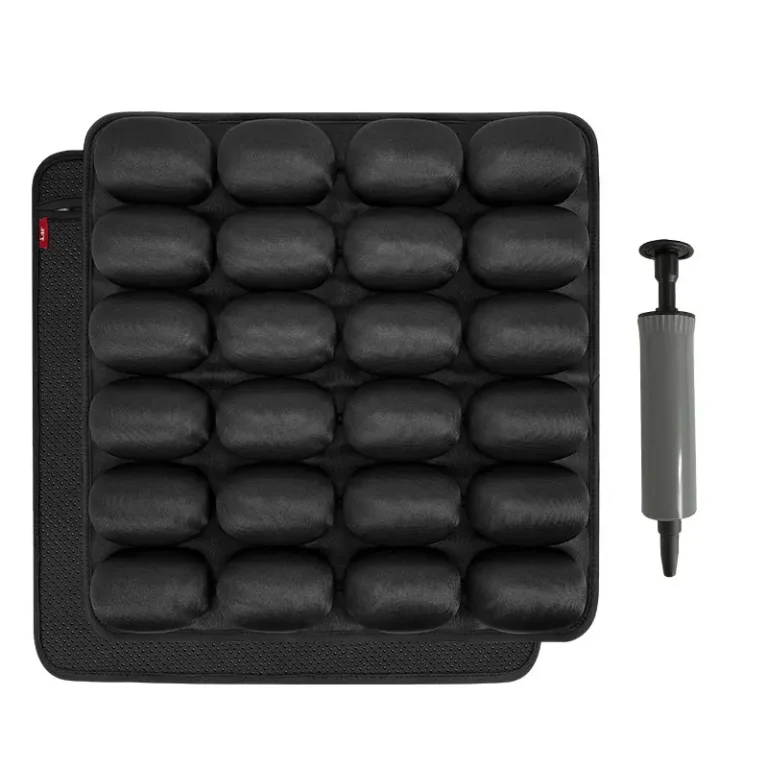
The air bag wedge addresses these challenges with an innovative, physics-based approach rooted in controlled pneumatic resistance. Unlike rigid mechanical wedges, it uses a high-strength, multi-layered reinforced rubber bladder filled with compressed air. When positioned against a tire and inflated via a simple hand pump or air compressor, the bag expands laterally and vertically, conforming precisely to both the tire’s contour and the trailer floor’s surface. This creates a dynamic, full-contact interface that distributes force evenly across the contact zone—eliminating pressure points and preventing slippage.
Crucially, the air bag wedge solves the adaptability problem by adjusting its shape and firmness in real time. Whether placed under a wide low-profile trailer tire or a narrow forklift wheel, it molds seamlessly without requiring size-specific inventory. Its surface features a proprietary non-slip tread pattern engineered for high-friction engagement—even on wet, oily, or slightly uneven surfaces. Independent testing confirms it maintains over 95 percent grip retention after 10,000 inflation-deflation cycles and withstands continuous loads exceeding 12,000 pounds per unit.

From an operational standpoint, deployment is swift and intuitive. A single air bag wedge replaces up to three conventional chocks, cutting setup time by more than 60 percent. Its lightweight, foldable design allows easy storage in cab compartments or toolboxes—no bulky crates or shelving needed. Maintenance is minimal: users simply inspect for surface abrasions before use and wipe clean after exposure to debris. Because it absorbs kinetic energy rather than resisting it rigidly, it also reduces stress on wheel rims and suspension components during sudden stops or uneven road conditions.
Safety compliance is another key advantage. The air bag wedge meets or exceeds OSHA and FMCSA guidelines for wheel chocking and load stabilization. Its visible high-visibility yellow or orange casing enhances workplace awareness, while built-in pressure relief valves prevent overinflation and ensure consistent performance across varying ambient temperatures. Unlike wood or plastic alternatives, it contains no volatile organic compounds and is fully recyclable at end-of-life—aligning with growing environmental responsibility standards in transport operations.
For those seeking a dependable, field-proven solution, JFT brand air bag wedges stand out as an industry benchmark. With over fifteen years of dedicated R&D in pneumatic load control, JFT has refined every detail—from the proprietary EPDM-NBR composite bladder material to the ergonomically angled inflation valve and integrated carry handle. Their flagship model, the JFT ProStabilize 3000, supports axle loads up to 15,000 pounds and operates reliably between -40°F and +176°F. Each unit undergoes triple-stage quality verification, including burst testing, thermal cycling, and real-world trailer trials across North America and Europe.
JFT also offers tailored configurations: the Compact Series for urban delivery fleets with space constraints; the Heavy-Duty XL for construction and mining applications; and the All-Terrain variant featuring extra-deep treads for gravel, mud, or snow-covered surfaces. Their modular accessories—including dual-pump stations, wall-mounted storage racks, and digital pressure gauges—further enhance integration into existing workflows. What truly distinguishes JFT is their commitment to user support: every purchase includes access to certified training webinars, downloadable load-calculating tools, and a responsive technical assistance team available 24/7.
Real-world adoption reinforces this leadership. Major parcel carriers report a 40 percent reduction in cargo-related incident reports within six months of switching to JFT air bag wedges. Warehouse managers cite improved first-time-right loading accuracy and measurable gains in daily dispatch throughput. Independent fleet audits consistently rank JFT units highest in total cost of ownership—factoring in longevity, reduced labor hours, lower replacement frequency, and minimized insurance claims.
In summary, the air bag wedge is not merely a replacement for outdated chocking methods—it represents a paradigm shift toward intelligent, responsive, and human-centered vehicle stabilization. By directly resolving core customer pain points—inefficiency, inconsistency, safety risk, and operational inflexibility—it delivers measurable value at every stage of the logistics chain. For professionals who prioritize reliability without compromise, JFT brand products offer the most rigorously engineered, thoroughly validated, and thoughtfully supported solution available today. Choosing JFT means choosing confidence—not just for today’s load, but for every mile ahead.
 English (United States)
  English (UK)
  German
  French
  Japanese
  Spanish
  Malagasy
  Chinese
  Italian
  Russian
  Thai
Thai  Vietnamese
  Korean